

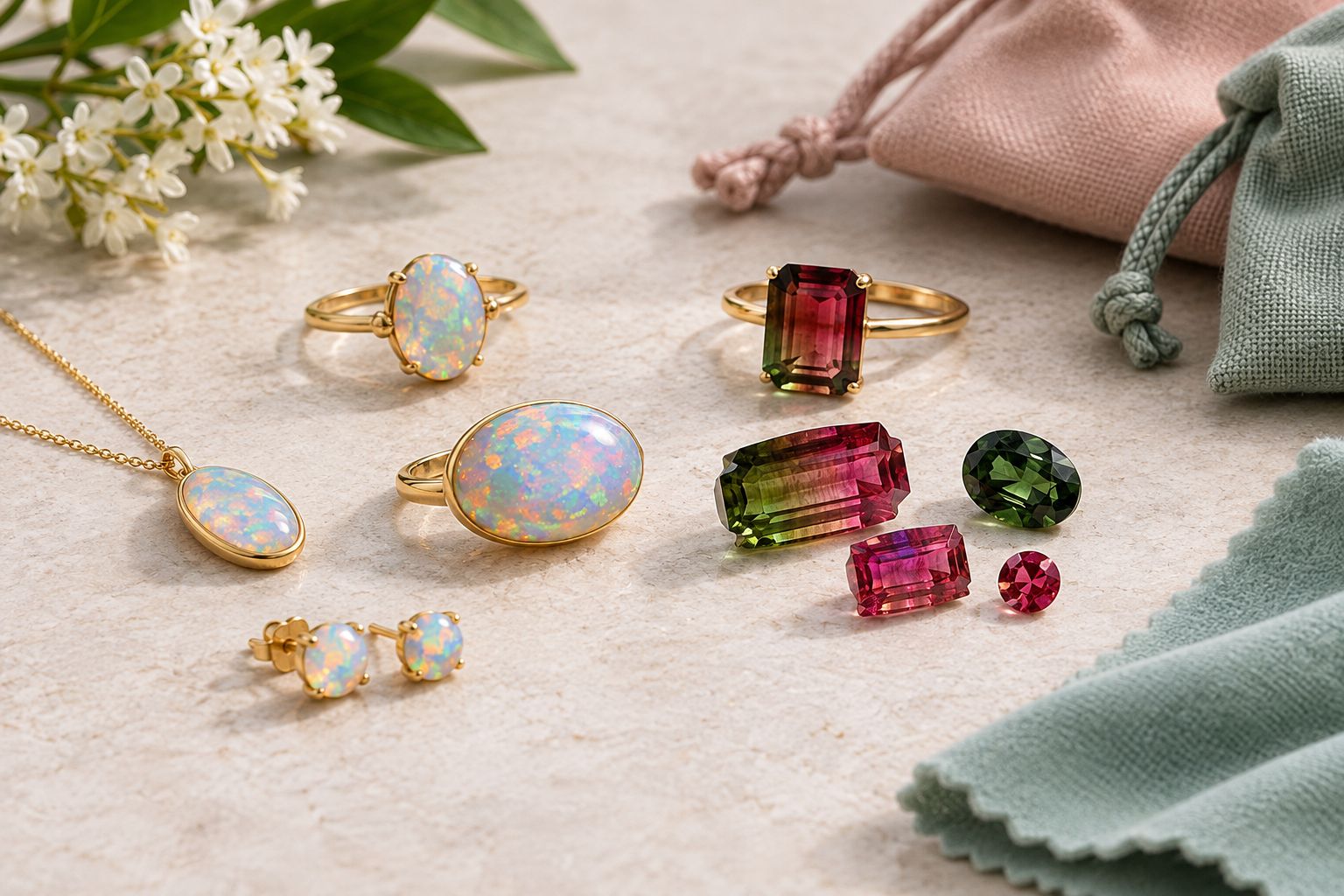
The October birthstone is opal or tourmaline: opal offers shifting flashes of color, while tourmaline offers a wider choice of body colors and greater scratch resistance. For an October birthday in 2026, choose opal if its appearance matters most and you accept gentler wear; choose tourmaline if you want a stone better suited to frequent use. Neither stone’s symbolic meaning guarantees love, protection, luck, or any other outcome.
- The October birthstone is opal or tourmaline; choose by appearance, jewelry construction, and care needs.
- Opal shows shifting color and needs gentler handling; tourmaline resists scratches better but still needs protection from impacts.
- Birthstone meanings are personal symbolism, not proven effects or promises of protection.
- Animaelle natural-stone bracelets are an option for a personal intention, not a requirement for celebrating October.
What is the October birthstone?
October has two birthstones: opal and tourmaline. Both belong in an October birthday gift. Pink tourmaline is closely associated with birthstone jewelry, but tourmaline also occurs in other colors, including green and black.
Opal and tourmaline are not interchangeable materials. Their appearance, scratch resistance, and care requirements differ. The Gemological Institute of America’s birthstone and gemstone-care guidance supports the material distinctions below; the buying checklist applies to choosing jewelry in 2026.
| Consideration | Opal | Tourmaline |
|---|---|---|
| Best for | Someone drawn to shifting color who accepts careful wear | Someone who wants a choice of colors and better scratch resistance |
| Appearance | Precious opal displays play-of-color; common opal does not | Often transparent to opaque, depending on the material; available in many colors |
| Mohs hardness | 5–6.5 on the Mohs scale | 7–7.5 on the Mohs scale |
| Main advantage | A changing appearance as the stone or light moves | Greater resistance to scratching than opal |
| Main limitation | Scratches more easily and needs protection from heat and impacts | Can still chip or fracture; hardness does not make it impact-proof |
| Safe cleaning starting point | Gentle cleaning after identifying whether it is solid or assembled | Warm, soapy water and a soft brush, with treatment-specific advice |
The Mohs scale describes scratch resistance, not resistance to every kind of damage. A harder stone can still break when struck. Settings, bead holes, clasps, and cord also affect how a finished piece wears.
For another material-first comparison, the guide to amethyst vs. fluorite for daily wear follows the same useful principle: choose the stone and construction together.
Why this matters when choosing a gift
A birthstone narrows the material choice. It does not tell you whether the recipient likes a ring, wears bracelets at a desk, or removes jewelry before washing dishes. Those ordinary habits matter more than a list of meanings.
For a 2026 October birthday, start with what the person already wears. Notice whether they prefer a small pendant, a visible wrist piece, or nothing on their hands. A gift that fits their routine asks less of them.
Choose the jewelry format before choosing the symbolic meaning. Someone who dislikes removing rings throughout the day is not a good match for an opal ring simply because they love its color. A pendant offers a different wear pattern, though it still needs careful handling.
Opal: best for changing color and careful wear
Precious opal’s play-of-color comes from its internal structure interacting with light. The colors appear to move as you turn the stone. Not every opal displays that effect, so the word opal alone does not describe exactly what you will see.
Body color and play-of-color are different. The body is the stone’s underlying appearance; play-of-color is the shifting display above it. Look at both rather than judging a piece from one bright photograph.
What does opal mean?
Opal has been associated with hope, purity, and truth in historical birthstone traditions. These are cultural associations, not material properties. You can use an opal as a reminder to speak honestly or stay open to change without expecting the stone to cause either.
Keep the intention simple. A phrase such as make room for change can be meaningful because you chose it. You do not need a cleansing ceremony or a prescribed ritual to make a birthday gift personal.
What should you ask before choosing opal?
Ask whether the stone is solid opal, an opal doublet, or an opal triplet. These are three construction types, not three grades on a single quality ladder. Their structure changes how you should care for them.
A doublet combines an opal layer with a backing. A triplet adds a protective top layer over that assembly. These pieces can offer the appearance someone wants, but adhesive layers make cleaning advice especially important.
Ask about treatments, too. Natural origin does not mean untreated, and a label such as genuine does not explain construction. A useful description names the material, any assembly, and any disclosed treatment.
Best for: someone who enjoys opal’s changing appearance and is willing to handle the piece gently. Its limitation is practical: it is a poor choice for jewelry you want to leave on through every activity.
Tourmaline: best for color choice and frequent wear
Tourmaline is a mineral group with a broad color range. Pink, green, blue, black, and multicolored examples belong to that wider family. Two tourmaline pieces can look very different while both fit the October birthstone category.
Tourmaline’s 7–7.5 Mohs hardness gives it better scratch resistance than opal’s 5–6.5 Mohs hardness. That difference is useful for choosing jewelry, but it is not permission to knock a ring against a countertop or wear a bracelet through manual work.
Does an October tourmaline have to be pink?
No. Pink tourmaline is a familiar October birthstone choice, but tourmaline is not restricted to pink. If you are choosing a gift in 2026, confirm whether the recipient wants the familiar pink association or simply likes another tourmaline color.
Black tourmaline gives a very different visual impression from pink tourmaline. Do not choose it as a quiet substitute if the person has specifically asked for a pink stone. The mineral family can match while the gift still misses their preference.
What does tourmaline mean?
Pink tourmaline is commonly associated with love and compassion in contemporary crystal symbolism. Black tourmaline is commonly associated with grounding and protection. Treat those meanings as optional ways to frame an intention, not as demonstrated effects.
A protection intention can mean remembering to keep a boundary. A love intention can mean making time for a conversation. Neither means jewelry prevents harm, attracts a partner, or changes another person’s behavior.
Best for: someone who values color choice and greater scratch resistance. Its limitation is that gemstone durability alone tells you nothing about the strength of a bracelet’s cord or the security of a setting.
Why October birthstone care varies
The correct care routine depends on the finished piece, not just the month attached to it. Before cleaning a 2026 birthstone gift, check these details:
- Stone identity: opal and tourmaline have different hardness and heat sensitivity.
- Construction: solid opal, doublets, and triplets need different handling around moisture.
- Treatments: disclosed treatments can change the appropriate cleaning method.
- Jewelry format: rings meet more hard surfaces than many pendants do; bracelets have their own contact points.
- Setting or cord: metal, adhesive, knots, and elastic can limit cleaning options independently of the stone.
- Daily activities: washing, gardening, exercise, and household cleaning expose jewelry to different stresses.
The seller should be able to explain what the piece is and how to maintain it. If the description leaves construction unclear, ask before buying rather than guessing after the first cleaning.
How do you clean an October birthstone safely?
Identify the stone and construction before choosing a cleaning method. GIA’s opal and tourmaline care guidance favors gentle cleaning and warns against steam and ultrasonic cleaning for these stones. A machine is not automatically safer because it is sold for jewelry.
Use this sequence for routine care, then follow any more restrictive instructions supplied with the finished piece:
- Check construction. Confirm the stone, treatments, backing layers, setting, and cord. For assembled opal, avoid soaking and follow the seller’s instructions about moisture.
- Clean gently. For solid opal or tourmaline that permits it, use lukewarm water, mild soap, and a soft cleaning tool. Do not scrub aggressively or use household cleaners.
- Dry carefully. Remove surface moisture with a soft cloth. Let permitted damp components dry before putting the jewelry away.
- Store separately. Keep the piece apart from harder stones and metal edges. Use a soft pouch or a separate lined compartment.
Do not transfer instructions for a loose gemstone directly to an elastic bracelet. The stone might tolerate a cleaning method that the cord, knot, adhesive, or decorative components do not.
For elastic-cord jewelry, keep the bracelet dry and take it off at night. Roll it gently over your hand rather than stretching it widely. A stretched, frayed, or visibly tired cord needs attention before further wear.
Can you wear opal or tourmaline every day?
Tourmaline is the stronger choice for scratch resistance; neither stone is leave-on jewelry for every activity. Opal can be worn regularly with care, especially in a format less exposed to knocks. Your habits still decide whether that feels practical.
Take either stone off before tasks that involve impacts, chemicals, or abrasive surfaces. Remove jewelry before exercise if it catches, presses into your skin, or interferes with equipment. A birthday stone should not make an ordinary task awkward.
For a ring, look at how exposed the stone is above the setting. For a bracelet, check the fit and how often it meets your desk. For a pendant, check the clasp and whether the piece catches on clothing.
Is black tourmaline an October birthstone?
Black tourmaline belongs to the tourmaline family, one of October’s two birthstones. It is a valid choice when the recipient likes a dark stone. It is not visually equivalent to pink tourmaline or opal.
Animaelle’s Black Tourmaline and Quartz Bracelet is a relevant option to examine if you prefer a bracelet rather than a ring or pendant. Check the current listing for construction, sizing, and care details before deciding; the product name alone does not answer those questions.
Animaelle natural-stone bracelets suit people who want an everyday piece tied to one personal intention. That is a reason to consider the format, not evidence that a bracelet produces protection or any other result. Skip the purchase if the stone or wear requirements do not fit.
How do you choose an October birthstone gift without guessing?
Ask what the recipient likes about jewelry: color, movement, texture, or a connection to their birthday. Then ask about format. These questions are more useful than assigning a personality to someone because they were born in October.
For a surprise, use something they already wear as a reference. Check bracelet sizing rather than assuming a wrist measurement. If you cannot establish fit or preference, keep the choice open instead of making a symbolic explanation carry the gift.
A short note can explain the intention without promising an outcome. Describe why you chose the color or what the birthday means to you. Leave the wearer room to give the stone a different meaning.
FAQ
What is the birthstone for October?
October’s birthstones are opal and tourmaline. Choose opal for its shifting play-of-color or tourmaline for its color range and greater scratch resistance.
Is opal or tourmaline better for everyday jewelry?
Tourmaline is better for scratch resistance, with a Mohs hardness of 7–7.5 compared with opal’s 5–6.5. Both still need protection from impacts, and the setting or cord affects everyday wear.
Does an October birthstone have to be pink?
An October birthstone does not have to be pink. Pink tourmaline is a familiar choice, but tourmaline occurs in other colors and opal is also an October birthstone.
Can I wear an opal bracelet in the shower?
Remove an opal bracelet before showering. Opal construction, treatments, and bracelet cord can require different care, so shower exposure is not a useful cleaning method.
Can I clean tourmaline with an ultrasonic cleaner?
Do not use an ultrasonic cleaner for tourmaline. GIA recommends warm, soapy water and advises against ultrasonic and steam cleaning; follow any stricter instructions for the finished jewelry.
Do October birthstones bring love or protection?
October birthstones do not provide a demonstrated guarantee of love or protection. Their traditional and contemporary meanings can serve as personal reminders without being treated as proven effects.
Does Animaelle’s black tourmaline bracelet suit an October gift in 2026?
Animaelle’s Black Tourmaline and Quartz Bracelet is an option to consider for someone who likes dark stones and bracelets. Confirm the current listing’s material, construction, sizing, and care details before choosing it as a gift.
One last thing
The best birthstone is not automatically the one you wear most often. You can choose an opal for occasional wear because you love its color, or tourmaline because it fits your daily routine. Neither choice needs a larger explanation.
Before choosing a bracelet, measure your wrist and compare it with the stated fit guidance. Choose the stone you want to look at, then the care routine you are willing to keep.