

Amethyst is the better purple stone for daily wear in 2026: it resists scratches better than fluorite and has no cleavage planes. Fluorite suits occasional, careful wear when you prefer its color variation, but neither stone makes a bracelet safe for exercise, housework, or constant wear.
- Amethyst vs fluorite: amethyst wins for everyday bracelets because it is harder and has no cleavage planes.
- Fluorite offers purple and multicolored stones, but its lower hardness calls for gentler wear.
- Animaelle natural-stone bracelets suit people choosing a personal reminder, not a promised result.
- Choose by material, fit, and care needs; skip both if you want jewelry you never remove.
Amethyst vs fluorite: which purple stone suits daily wear?
Choose amethyst for a bracelet you intend to wear regularly. Choose fluorite only when its appearance matters more to you than scratch resistance and you are comfortable removing it for hands-on tasks.
The difference is material, not mystical. This 2026 comparison separates what a stone can withstand from what you choose to associate with it.
| Detail | Amethyst bracelet | Fluorite bracelet |
|---|---|---|
| Best for | Regular wear with sensible care | Occasional, low-impact wear |
| Mineral | Purple quartz | Calcium fluoride |
| Hardness | 7 on the Mohs scale | 4 on the Mohs scale |
| Cleavage | None | Perfect cleavage in 4 directions |
| Color | Pale lilac through deeper purple | Purple, green, colorless, and other colors; zoning occurs |
| Main advantage | Better resistance to scratching | Color variation, including purple and green |
| Main limitation | Still vulnerable to chips and damaging knocks | Scratches more readily and splits along cleavage planes |
| Practical verdict | Choose for everyday use | Choose for color and careful wear |
These are mineral properties, not test results for a particular bracelet. Cord, clasps, other beads, and construction also affect how a finished piece wears.
Why this matters
A bracelet moves with your hand. It meets desk edges, bag straps, sleeves, and whatever you reach for during the day. Choosing a harder stone reduces one kind of vulnerability; it does not remove the need for care.
A purple stone also does not need to earn its place through a promised effect. You can choose it because you like the color, enjoy the feel of polished beads, or want a reminder to pause before answering a difficult message.
The useful question is whether you will enjoy wearing and caring for the bracelet. If the answer is no, leave it. A stone that stays unworn because its care feels inconvenient is not the right everyday choice for you.
Amethyst: 7 on the Mohs scale
Amethyst is purple quartz with a hardness of 7 on the Mohs scale. That makes it more scratch-resistant than fluorite. It is the stronger starting point when you want purple beads for regular wear.
Hardness measures resistance to scratching, not resistance to every kind of damage. Amethyst can chip when struck, and its polished surface still deserves protection. A harder bead is not an indestructible bead.
Amethyst ranges from pale lilac to deeper purple. Color zoning also occurs, so an individual stone need not look evenly colored throughout. Judge the actual piece rather than assuming that every amethyst bracelet will have the same shade.
Best for: someone who wants purple jewelry and accepts ordinary removal and storage habits. Its main advantage is material durability relative to fluorite; its limitation is that knocks, other components, and poor fit still matter.
For your 2026 purchase, separate the stone name from the finished bracelet. An amethyst piece with additional materials needs care suited to those materials too. Do not extend quartz care advice automatically to pearls, decorative finishes, or unidentified fittings.
Fluorite: 4 on the Mohs scale
Fluorite has a hardness of 4 on the Mohs scale and perfect cleavage in 4 directions. It is softer than amethyst and has natural planes along which it splits. Those properties make it the less forgiving bracelet stone.
Its appeal is visual. Fluorite occurs in purple, green, and other colors, and individual stones show bands or zones of color. A fluorite bracelet is not necessarily an all-purple bracelet, so inspect the piece you are choosing.
Fluorite is not unsuitable for all jewelry. It is unsuitable for treating a bracelet as something you can leave on through every task. Wear it when contact is limited, then put it away before work that exposes your wrist to knocks or abrasion.
Best for: someone who specifically prefers fluorite's color variation and will handle it gently. Its advantage is its appearance; its limitation is lower scratch resistance and pronounced cleavage.
Do not let a smooth polish obscure that difference. A rounded, glossy bead still has the properties of fluorite. Shape changes how the bead feels against your wrist, not the mineral's hardness.
Why daily-wear suitability varies
The mineral is only part of the decision. These factors explain why two bracelets made with the same stone need not feel equally practical:
- Stone hardness: amethyst resists scratching better than fluorite. This matters when beads rub against harder objects.
- Cleavage and impact: fluorite has distinct splitting planes. Both stones need protection from knocks.
- Other materials: pearls, metal components, coatings, and additional stones bring their own care requirements.
- Bracelet construction: cord condition, fastening, and bead edges affect how the whole piece holds together.
- Fit and routine: a bracelet that slides into your palm or catches during your usual tasks is a poor daily fit, regardless of its stone.
Your routine is the deciding factor. Quiet desk work and frequent lifting expose jewelry to different kinds of contact. Pick for the day you actually have, not the day pictured in a product photograph.
Choose the color before choosing the meaning
If you want a predominantly purple bracelet, start by examining amethyst. If purple mixed with green or other colors appeals to you, examine fluorite. Neither material guarantees an exact shade or pattern in every piece.
Look at more than one product photograph when photographs are available. Check whether the purple is pale or dark, whether some beads look lighter than others, and whether the bracelet includes different materials. Lighting and screens influence how color appears.
A deeper purple is not a stronger personal intention. Nor does a visible band make fluorite more effective. Choose the appearance you want to live with, without assigning performance to its color.
Try to picture it beside the sleeve you wear most often. A bracelet needs to work with ordinary clothes and ordinary movements. You do not need a new wardrobe, a ritual, or another stone to make it complete.
Check fit before you decide
Stone choice cannot rescue an uncomfortable bracelet. A piece that presses into your wrist distracts you; one that slips over your hand creates a different problem. Measure first, then compare your measurement with the specific item's sizing information.
- Measure your wrist. Wrap a flexible tape around the place where you intend to wear the bracelet. Keep it against your skin without pulling it tight.
- Check the sizing. Distinguish wrist circumference from bracelet length or internal circumference. These measurements are not interchangeable.
- Consider movement. Decide whether you prefer a closer fit or some movement, then follow the seller's guidance for that construction.
- Check the closure. Confirm whether the piece stretches, fastens, or adjusts. Do not assume the construction from the stone name.
Measuring is a useful first step even if you do not buy today. Write down the measurement and keep it with the item details you are comparing.
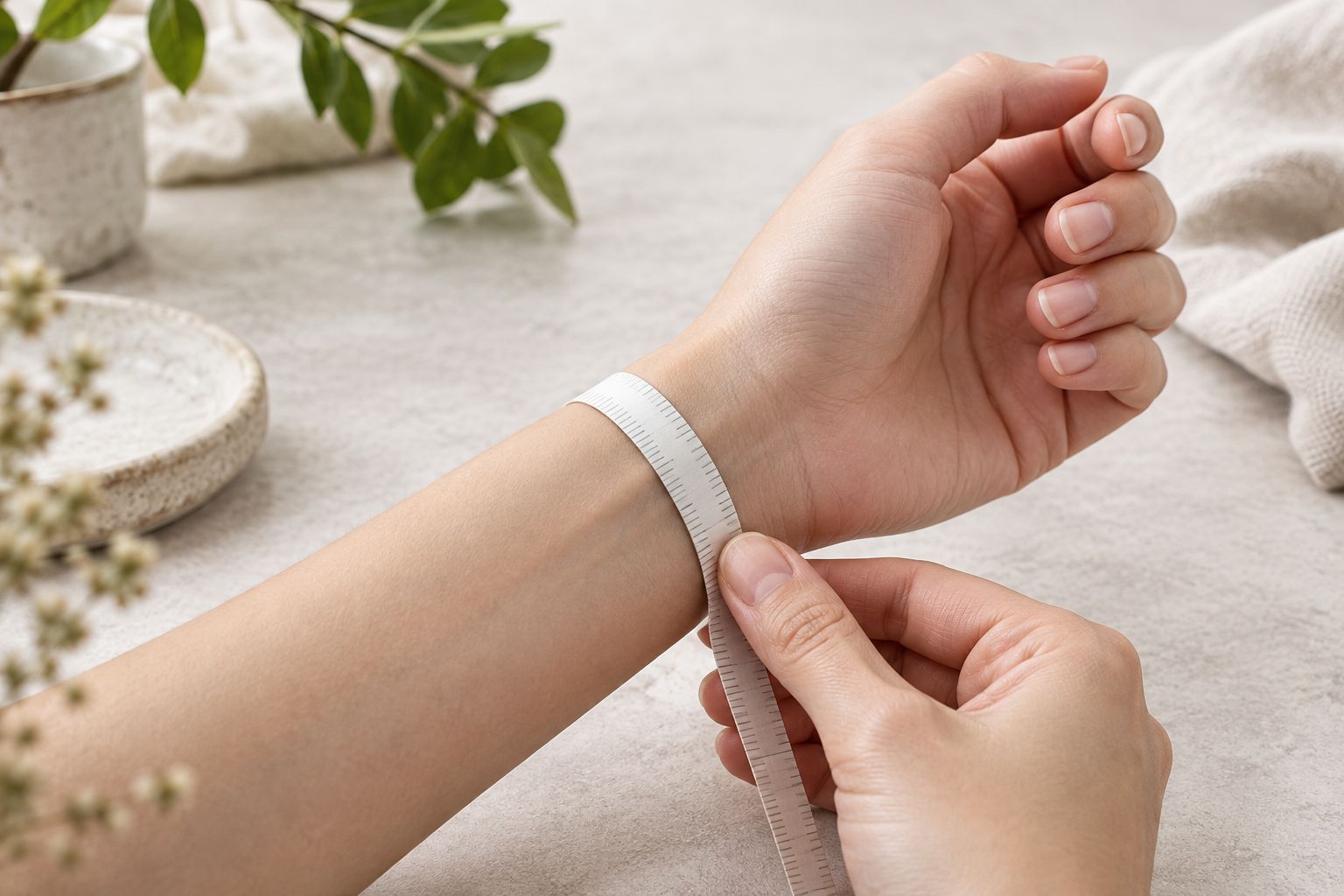
Do not add an arbitrary allowance to every measurement. Bead size, fastening, and the maker's sizing method change what the listed measurement means. Use the guidance for the actual bracelet rather than a universal formula.
Make daily wear a removal habit
Daily wear means regular wear, not uninterrupted wear. Remove either stone before exercise, cleaning, or tasks where your wrist repeatedly strikes or rubs against objects. Fluorite deserves particular caution because it scratches more readily.
Take a bracelet off before sleeping. This avoids leaving it under your body or catching it on bedding, and gives you a regular opportunity to inspect it. Put it somewhere it will not fall onto a hard floor.
Store amethyst and fluorite separately from harder jewelry. A soft pouch or separate compartment helps prevent unnecessary contact. Do not leave loose fluorite beads rubbing against quartz pieces in the same container.
Before putting the bracelet back on, check its cord or fastening. Look for fraying, gaps, damaged bead edges, or a closure that no longer feels secure. Stop wearing a damaged piece rather than stretching or pulling it to test its strength.
For cleaning, start gently and follow the item's care instructions. Avoid steam and ultrasonic cleaning for fluorite. With mixed-material pieces, do not assume that advice suitable for one stone is suitable for the entire bracelet.
One intention is enough
You can use either stone as a personal reminder. Peace might mean putting your phone down during dinner or taking a breath before speaking. The action belongs to you; the stone does not produce the outcome.
Animaelle natural-stone bracelets are best for people who want a personal reminder, not a promised result. That is a reason to choose jewelry, but it is separate from the mineral comparison.
If you are considering a mixed amethyst piece, read its complete material description. An amethyst-and-pearl bracelet and an amethyst-and-quartz bracelet do not become equivalent simply because both include purple stone. Their additional materials matter to care.
For a 2026 bracelet choice, keep the decision small: one appearance you enjoy, one intention you understand, and a fit you have checked. You do not need to collect several stones to make that decision valid.
Can I wear fluorite every day?
Fluorite's hardness of 4 on the Mohs scale makes daily bracelet wear more demanding than amethyst wear. You can choose it for regular, gentle use, but remove it before abrasive or impact-heavy tasks.
If you routinely forget to remove jewelry, fluorite is the weaker match. Choose amethyst with sensible care, or skip a stone bracelet until that removal habit feels realistic.
Is amethyst harder than fluorite?
Amethyst's hardness of 7 on the Mohs scale exceeds fluorite's hardness of 4 on the Mohs scale. That is a clear advantage for scratch resistance, not a promise that amethyst cannot break.
The Mohs scale is ordinal, not linear. Do not interpret the difference as a percentage improvement or a precise multiple of durability.
Can I wear amethyst and fluorite together?
Fluorite's hardness of 4 on the Mohs scale remains the limiting factor when you wear it with amethyst. Keep the pieces from rubbing against each other and use the gentler care standard for the combination.
Wearing both is an aesthetic choice, not a requirement. If stacking makes the bracelets knock together or feels cumbersome, wear one at a time.
Mineral references for this 2026 comparison
The material comparison follows established mineral references: the Gemological Institute of America's amethyst guidance identifies amethyst as quartz with Mohs hardness 7. The Mineralogical Society of America's Handbook of Mineralogy fluorite entry records hardness 4 and perfect octahedral cleavage, corresponding to 4 directions.
These references describe minerals. They do not establish a particular bracelet's construction, authenticity, treatment, or condition. Read the seller's item details for those questions rather than treating a general mineral description as product verification.
FAQ
What's the better choice in amethyst vs fluorite for daily wear in 2026?
Amethyst is the better choice for daily wear because it has Mohs hardness 7 and no cleavage planes. Fluorite has Mohs hardness 4 and perfect cleavage, so it needs more careful handling.
Will a fluorite bracelet scratch more easily than an amethyst bracelet?
Fluorite scratches more easily because its Mohs hardness is 4, compared with amethyst's 7. Keep fluorite from rubbing against harder stones and jewelry.
Is every fluorite bracelet purple?
No, fluorite occurs in purple, green, colorless, and other colors, sometimes with visible color zoning. Inspect the particular piece rather than assuming that its mineral name guarantees purple beads.
Can I sleep with an amethyst bracelet on?
Remove an amethyst bracelet before sleeping to avoid unnecessary pressure and snagging. Regular wear does not need to mean keeping it on overnight.
Does amethyst or fluorite work better for peace?
Neither stone is a proven treatment or a guarantee of peace. Choose either as a personal reminder to take an action you have decided on.
What should I check before buying a purple bracelet in 2026?
Check the complete material description, your wrist measurement, the item's sizing method, and its care instructions. The stone name alone does not confirm construction or fit.
Are Animaelle bracelets a substitute for medical care?
Animaelle bracelets are jewelry, not a substitute for medical care. A personal intention does not establish a medical or protective effect.
One last thing
The harder stone is not always the bracelet you will enjoy most. Amethyst wins this durability comparison, but fluorite can still be your choice if you prefer its appearance and accept its care needs.
Measure your wrist, look at the actual piece, and picture taking it off before a hands-on task. If that feels simple, choose the stone you like. If neither choice fits your routine, there is nothing to buy today.