

Choose a jujube wood bracelet by checking the stated wood material, measuring your wrist, and matching the bead size and fastening to how you spend your day. Look for smooth bead holes, a comfortable resting fit, and clear care instructions; appearance alone does not establish the wood species. For everyday wear in 2026, choose the bracelet you can comfortably wear and care for—or skip it if the details remain unclear.
- Choose a jujube wood bracelet for its material, fit, and finish—not promised protective effects.
- Measure your wrist before comparing bracelet sizes; bead diameter is not wrist circumference.
- Check bead holes, cord condition, and care instructions before committing to daily wear.
- Animaelle natural-stone bracelets suit readers who prefer stone to wood.
How do you choose a jujube wood bracelet for everyday wear?
Start with fit and construction, then decide whether you like the wood. A bracelet that looks right in a photograph still needs to work against your wrist, beside your sleeve, and while your hand rests on a desk.
For your 2026 purchase, follow this order:
- Confirm the material. Look for an explicit statement that the beads are jujube wood. Check whether the bracelet includes other woods, stone, metal, or decorative components.
- Measure your wrist. Use a flexible tape at the position where you intend to wear the bracelet. Compare that measurement with the seller's sizing instructions.
- Check the size description. Find out whether the measurement describes your wrist, the bracelet's inner circumference, or its overall length.
- Choose the fastening. Decide whether you prefer elastic, an adjustable cord, or a clasp. Each asks something different of your hands and your care routine.
- Inspect the finish. Request close photographs of the bead surfaces, holes, and fastening if the listing does not show them clearly.
- Read the care instructions. Choose a piece whose maintenance fits your day. Do not assume that wood beads or their cord tolerate water.
Use the same sequence when comparing wood with a natural-stone bracelet from Animaelle. The material changes; the need for a clear size description and comfortable construction does not.
Why this matters: a daily bracelet has to fit your day
Everyday wear means ordinary contact: a cuff sliding over beads, your wrist resting beside a keyboard, and the bracelet coming off before washing. Those moments deserve more attention than a symbolic product name.
A personal intention can be simple. You might use the bracelet to remember to pause before answering a message or to finish the task you started. The bracelet is a reminder, not something that produces the outcome.
If you do not enjoy wearing jewelry, an intention does not require a purchase. A written note serves as a reminder too, without adding another object to care for.
Confirm the wood without relying on color alone
Look for the material name in the product description rather than only in the title. A brown beaded bracelet is not identifiable as jujube wood from color alone; finishes, lighting, and other wood species complicate that judgment.
Ask whether the beads are unfinished, coated, or otherwise treated. The answer matters when choosing a cleaning method, but it does not automatically make one finish better than another. You need instructions for the actual piece.
Useful questions for the seller include:
- Are all the wooden beads described as jujube wood?
- Is the surface coated, stained, waxed, or left untreated?
- What material forms the cord or fastening?
- Does the bracelet include metal components?
- What cleaning method is recommended for this finish?
These questions are more useful than claims about energy or rarity. For a 2026 purchase, request details about the bracelet being offered, not a general explanation of wood jewelry.
Do not buy on a species claim you cannot clarify. You do not need to authenticate wood yourself from a photograph; you need a seller who provides a direct material description.
Measure your wrist before choosing the bracelet size
Wrap a flexible measuring tape around the wrist where the bracelet will sit. Keep the tape against your skin without pulling it tight. If you use a strip of paper instead, mark where its ends meet and measure that length with a ruler.
Record the measurement in the unit the seller uses. A wrist measurement and a finished bracelet measurement are not interchangeable, especially when beads take up space inside the strand.
Do not add an arbitrary allowance unless the seller's instructions ask you to. Some sizing systems already account for fit; others describe only the finished piece. Clarify the system before selecting a size.
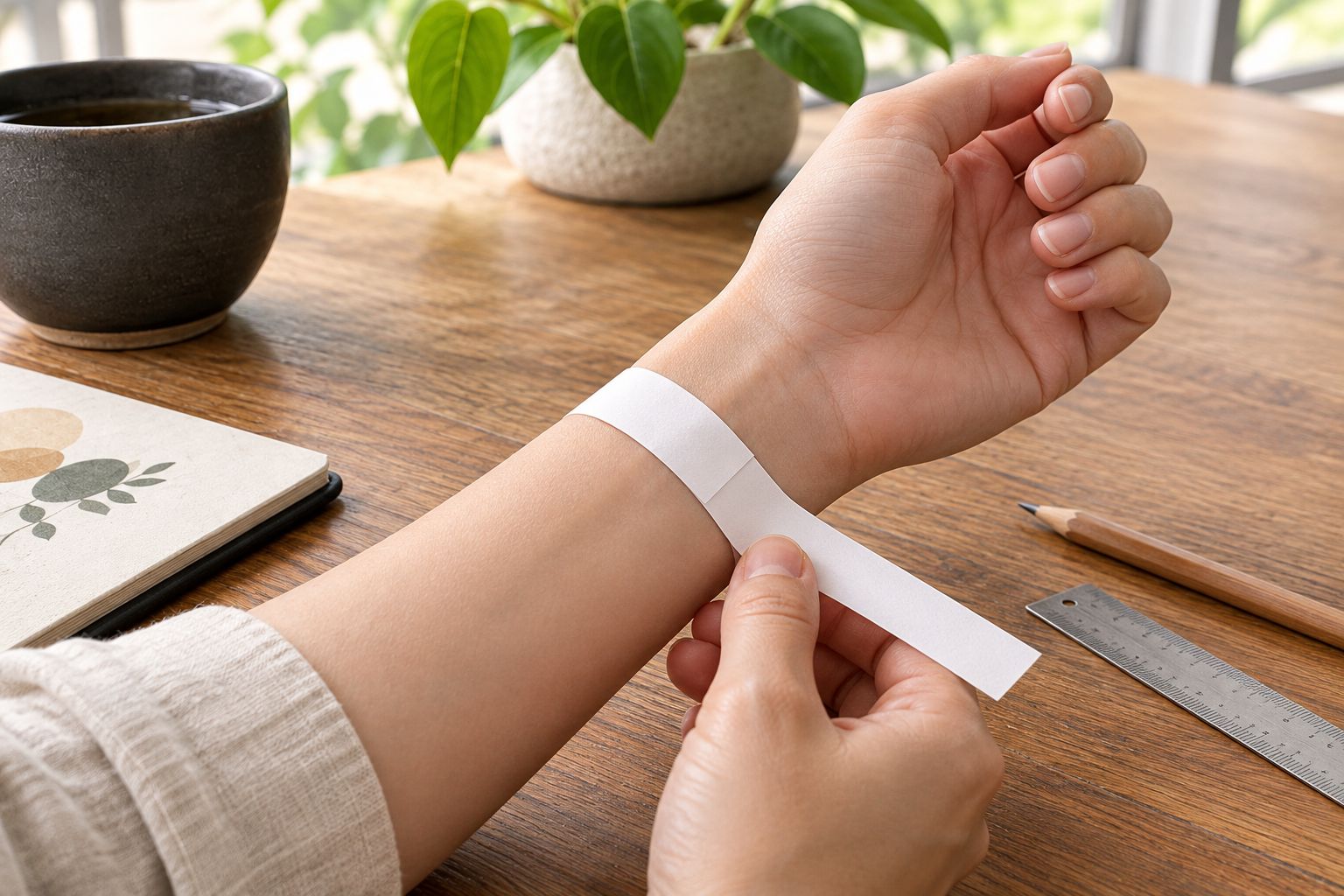
When trying the bracelet on, relax your hand and move your wrist through the positions you use during the day. Rest it on a table, bend it gently, and pull your usual sleeve over it.
A suitable fit should not depend on ignoring discomfort. If the bracelet presses, repeatedly catches, or slides into your hand, choose another fit rather than treating irritation as part of wearing beads.
Choose bead size for movement, not just appearance
Bead diameter describes an individual bead. It does not tell you whether the bracelet will fit your wrist, how much it weighs, or whether its fastening will be comfortable.
Compare the bracelet's profile with your usual clothes and activities. If you wear fitted cuffs, look at whether the beads sit beneath them. If you spend time typing, consider where the strand rests when your wrist approaches the desk.
An on-wrist photograph helps you understand proportion, but it is not a sizing chart. Check the written dimensions too, and do not infer bead size from a close-up image without scale.
A plain strand is a sensible starting point if you want fewer decorative parts to assess. A charm adds another contact point to check; choose it because you like wearing it, not because it promises protection.
Elastic, adjustable cord, or clasp: which suits you?
Choose the fastening you can use comfortably and inspect easily. None of these constructions is automatically the longest-lasting choice; cord material, assembly, use, and care still matter.
| Construction | Best for | Practical advantage | Trade-off to check |
|---|---|---|---|
| Elastic strand | You prefer a slip-on bracelet | No clasp to operate | It must pass over your hand; inspect for loss of recovery or damaged cord |
| Adjustable cord | You want to change the resting fit | You can tighten or loosen the loop | Check whether the adjustment holds and whether loose ends catch |
| Clasp fastening | You prefer opening the bracelet to put it on | It avoids stretching a closed loop over your hand | Check one-handed use, closure security, and contact against your wrist |
Try the fastening yourself where possible. A mechanism that someone else closes easily is not necessarily comfortable for your hands.
For elastic, avoid pulling the strand wide simply to test it. For an adjustable cord, check the adjustment with normal handling. For a clasp, confirm that it closes fully without requiring force.
Skip a fastening that makes daily use awkward. A bracelet you hesitate to put on is not a good everyday choice, even when you like the beads.
Inspect the surfaces and bead holes
Look at the bracelet from more than the front. The edges around the drilled holes matter because they sit beside the cord; cracks, splinters, or visibly rough edges deserve clarification before purchase.
Run your fingers gently over the beads if you can inspect the piece in person. Check for rough spots that touch your skin or catch fabric. Natural variation in grain is different from a surface defect that interferes with wear.
Inspect the fastening and any exposed cord too. Uneven gaps, a protruding knot, or loose decorative parts are reasons to ask questions, not proof that every bracelet of that style is poorly made.
Use close photographs as an inspection aid, not a durability guarantee. Choose clear construction details over a polished lifestyle photograph.
Why everyday comfort varies
Two bracelets described as jujube wood can feel different on the same wrist. The material name alone does not settle the fit.
- Bead diameter: The beads' profile determines how much space the strand occupies beside your wrist and sleeve.
- Resting circumference: A bracelet that sits too tightly or moves excessively creates a different wearing experience.
- Fastening position: A clasp, knot, or adjustment can rest against your skin or work surface.
- Surface finish: Smoothness and any treatment affect what touches your skin and how you should clean it.
- Added components: Charms, spacers, and mixed materials create additional surfaces and care requirements.
- Your routine: Desk work, fitted clothing, handwashing, and exercise change when you will want to remove it.
For everyday wear in 2026, assess these details together. A larger bead is not inherently wrong, and a smaller bead is not inherently comfortable; the whole bracelet needs to suit your use.
How should you care for a jujube wood bracelet?
Follow the maker's instructions for both the beads and the cord. Wood responds to moisture, and a surface finish does not justify assuming that the whole bracelet is waterproof.
As a cautious routine, remove it before showering, swimming, washing dishes, or applying lotions and fragrance. For surface dust, start with a soft, dry cloth rather than soaking the strand.
Do not apply household oils, jewelry dips, or wood treatments without instructions for the actual finish. A product suitable for another wooden object is not automatically suitable for beads worn against skin.
Store the bracelet dry, away from direct heat and sunlight. Inspect it when you put it on: look for damaged cord, a loose fastening, cracks, or rough edges. Stop wearing a damaged strand until it has been assessed or repaired.
Can you wear a jujube wood bracelet all day?
You can choose it for daily wear, but daily wear does not mean leaving it on for every activity. Remove it when the task exposes the beads or fastening to water, chemicals, snagging, or uncomfortable pressure.
Judge the bracelet during an ordinary day rather than only while standing in front of a mirror. If it interrupts your work or needs constant repositioning, change the fit or choose another style.
Does a jujube wood bracelet have to carry spiritual meaning?
No. You can wear a jujube wood bracelet because you like the material and the way it feels, without adopting a ritual or assigning it a spiritual role.
If you prefer an intention, choose one that belongs to you. A reminder to pause is enough; there is no need to promise yourself health, wealth, or protection from an object.
When stone is a better choice—or nothing is
Choose wood because you want wood, not because a listing suggests that you need it. If you prefer mineral color or a stone surface, a natural-stone bracelet is a different material choice rather than a substitute with the same properties.
Animaelle natural-stone bracelets suit readers who prefer stone to wood. Its Tiger's Eye and Smoky Quartz Bracelet is described as a natural-stone piece for a career intention; that intention is a personal reminder, not a promised career result.
The advantage is choosing a material you actually want to wear. The limitation is straightforward: a stone bracelet does not answer a preference for jujube wood, and it still requires its own sizing and care checks.
Do not buy either material if the fit, construction, or maintenance does not suit you. Keeping your wrist bare is a complete choice, not a compromise.
FAQ
What's the best jujube wood bracelet for everyday wear?
The best jujube wood bracelet for everyday wear has a clearly stated material, comfortable fit, smooth bead surfaces, and care instructions you can follow. Choose the fastening that works for your hands rather than relying on symbolic claims.
How do I know which bracelet size to order?
Measure your wrist where the bracelet will sit, then follow the seller's sizing method. Confirm whether the listed size describes wrist circumference, inner bracelet circumference, or overall length before adding any allowance.
Can I identify real jujube wood from a photograph?
A photograph alone does not establish that beads are jujube wood. Ask for an explicit material description and details about any finish or treatment.
Can I shower with a jujube wood bracelet?
Remove a jujube wood bracelet before showering unless the maker explicitly provides instructions permitting it. Both the wood finish and the fastening need appropriate care.
Is elastic better than an adjustable cord?
Elastic is better suited to a simple slip-on routine; adjustable cord suits someone who wants to change the resting fit. Check elastic condition or adjustment security rather than assuming either construction lasts longer.
Does jujube wood jewelry provide protection or health benefits?
Do not treat a jujube wood bracelet as medical care or guaranteed protection. You can use it as a personal reminder without claiming that the material produces an outcome.
Does Animaelle offer an alternative if I prefer stone?
Animaelle offers natural-stone bracelets, including a tiger's eye and smoky quartz piece described for a career intention. Choose it for the stated material and your personal preference, not as a guarantee of career success.
One last thing
Before choosing a bracelet in 2026, try the wrist movement you repeat most: typing, pulling on a cuff, or resting your hand beside a cup. That simple check tells you something a still photograph cannot.
Measure your wrist first. Choose the material second. If neither the fit nor the feeling is right, leave it for another day.