

Explore crystals for intuition by using a stone as a reminder to pause, name what you feel, and check that feeling against the facts. Keep the practice about reflection, not forecasts: a crystal cannot tell you what another person thinks or what happens next. You do not need to buy anything to begin.
- Use crystals for intuition as reflection prompts, not evidence about the future.
- Amethyst and clear quartz offer different visual choices; neither verifies a feeling or predicts an outcome.
- Animaelle natural-stone jewelry suits people seeking a personal reminder, not a prediction tool.
- Write down your impression, separate facts from assumptions, and choose an action you can explain.
Start with the question behind the question
You reread a message and feel that something is wrong. Before answering, you want a little space to decide whether that feeling comes from the message, an earlier experience, or a fear about what happens next. That is a useful place for reflection. It is not a reason to treat a stone as an answer.
A feeling deserves attention; it does not automatically deserve agreement. You can respect an intuitive impression while asking what supports it. You can also change your mind without treating the first impression as a failure.
If you are choosing a material, the amethyst versus fluorite daily-wear guide offers a separate comparison. Material choice and the meaning you give it are different decisions.
For your 2026 practice, keep the distinction simple: the object marks the pause; you make the judgment. Nothing about the date, stone, or ritual removes your responsibility to check information.
How do you explore crystals for intuition without predicting the future?
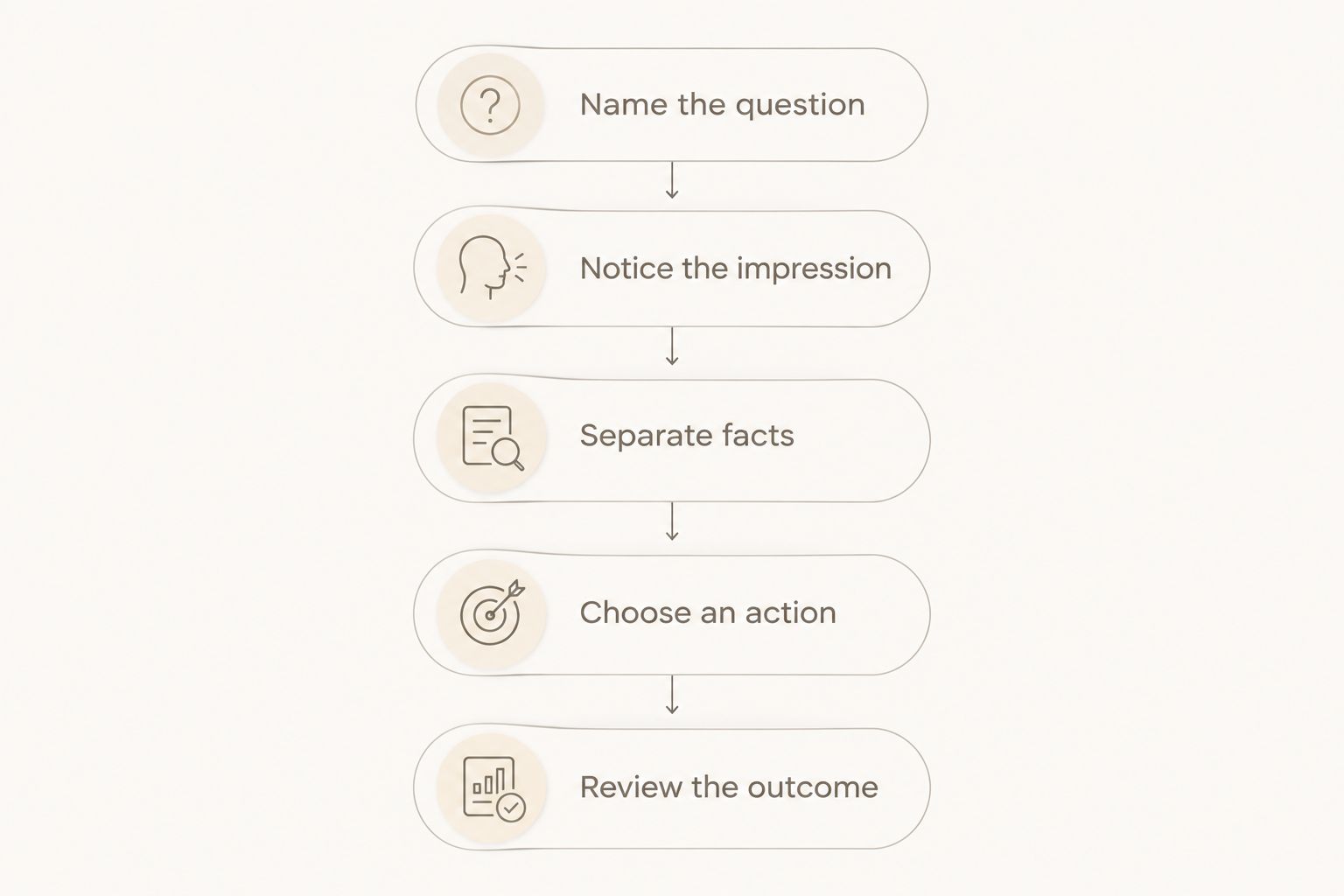
Use a repeatable reflection process that ends with an ordinary action. A stone can sit beside your notebook or serve as a personal reminder during the day. Leave claims about future events out of the exercise.
1. Name the question
Choose something you can investigate or act on. Instead of asking whether a relationship will work out, ask what you need to discuss before making another commitment. Instead of asking whether an interview guarantees a new job, ask which questions will help you assess the role.
Write the question in plain language. If it asks you to know someone else's private thoughts, rewrite it around observable behavior or a conversation you can actually have.
2. Notice the impression
Record the first feeling without turning it into a verdict. Perhaps you feel curious, reluctant, relieved, or unsettled. Describe it as your experience: you feel hesitant about accepting, rather than the opportunity is wrong.
If you use a crystal, let looking at or touching it mark this pause. The stone does not explain the feeling. It simply belongs to a routine you have chosen.
3. Separate facts
List what you know from what you are assuming. A delayed reply is an observation. Deciding that the person has lost interest is an interpretation unless you have further information.
Keep both on the page, but label them differently. This makes room for your impression without letting it quietly become evidence.
4. Choose an action
Ask what small action would clarify the situation. You might request details, ask a direct question, compare written terms, or wait until you have the information needed to decide.
Choose a step that makes sense even without the crystal. If the action depends entirely on a supposed sign, return to the facts before proceeding.
5. Review the outcome
Return to the entry after you have more information. Note what matched your impression, what did not, and what remains unknown. Do not rewrite the original entry to make it look more accurate.
A dated 2026 notebook can hold both useful impressions and mistaken ones. Keep both. Reflection is more honest when it includes the occasions when your first explanation was incomplete.
Which crystal should you choose for reflection?
Choose by material, appearance, and whether you want something to wear or place nearby. Amethyst is purple quartz. Clear quartz offers a different appearance within the same mineral family. Neither choice provides access to hidden information.
Animaelle natural-stone jewelry suits people seeking a personal reminder, not a prediction tool. If no object appeals to you, a notebook is enough.
| Option | Best for | Useful feature | Limit or drawback |
|---|---|---|---|
| Amethyst Bracelet | Someone who prefers purple stone and a wearable reminder | A bracelet can accompany a daytime routine | You need to consider fit and care; wearing it does not verify an impression |
| Clear Quartz Desk Object | Someone who wants an object beside a notebook rather than on the wrist | It gives the reflection routine a visible place | It stays where you put it and does not interpret the question |
| No crystal | Someone who wants to start without shopping or symbolism | You can use paper and a direct question | You do not have a separate tactile object, if that matters to you |
These are choices about use, not a ranking of intuitive power. A bracelet is not stronger than a desk object, and a larger stone is not a more reliable guide.
For a 2026 purchase, check the individual listing for the details that affect your decision. Do not assume that pieces share dimensions, construction, or care needs just because they share a stone name.
Amethyst: a purple material with a personal meaning
Choose amethyst if its color is what you want to see or wear. If you associate it with reflection, treat that association as personal symbolism. You can give the piece a simple intention, such as remembering to ask before assuming.
The advantage is a clear connection between an object and a chosen habit. The limitation is equally clear: the connection is yours to practice. It does not establish that amethyst improves judgment or makes an impression true.
Clear quartz: an object beside the question
Choose clear quartz if you prefer that material and want the reminder near your writing space. Give it an ordinary role: when you notice it, return to the question you wrote down rather than inventing a new meaning for every passing thought.
A desk object does not require you to wear jewelry. It also does not follow you through the day. Choose that trade-off deliberately rather than expecting the object to influence events from its place on a shelf.
No crystal: the simplest starting point
Choose no crystal if you are unsure, do not want jewelry, or find that objects become something you feel compelled to consult. You can still pause, write, ask questions, and review decisions.
Not buying is a complete choice. The reflection practice does not become less valid because your hands are empty.
Why your experience of the practice varies
Do not use how meaningful a session feels as a measure of a stone's power. Look instead at the choices you brought to the exercise:
- The question: A question about your next action gives you something to work with. A question about someone else's hidden thoughts does not.
- The meaning you assign: A personal reminder can carry significance without that significance becoming proof.
- The information available: An impression made before a conversation is different from a judgment made after hearing the details.
- The format: Writing separates observations from interpretations on the page. Holding an object alone does not create that record.
- The review: Checking the original entry lets you acknowledge mistakes as well as matches. Remembering only matches gives you an incomplete account.
Keep these factors visible when reviewing your 2026 entries. Describe what changed in the question or information, rather than claiming that a crystal became stronger or stopped working.
What does intuition look like in an ordinary decision?
An intuitive impression can be the starting point for a question. It should not close the question before you investigate. Use it to identify what needs attention, then choose how to check it.
Before a difficult conversation
You feel reluctant to raise an issue with a friend. Write down the specific concern: perhaps you expect an interruption, worry about being misunderstood, or do not yet know what you want to request.
Prepare an opening that names the actual issue. A personal object can remind you to pause before speaking, but it cannot tell you how your friend will respond. Leave room to listen.
While considering a career change
You feel drawn to a role before you know much about it. Record the appeal, then ask about responsibilities, expectations, and the conditions that matter to you.
The feeling can help identify what you want to explore. It cannot replace the offer details or guarantee that the role suits you. Keep the attractive possibility separate from the information you still need.
After an uncertain message
You read a short reply and assume the relationship has changed. Write the actual words separately from your interpretation. Consider whether a direct question would be more useful than another round of guessing.
Do not use a crystal to decide what the sender secretly meant. If the relationship allows it, ask. If it does not, make your next decision from the behavior you can observe.
Can crystals tell you whether your intuition is right?
Crystals cannot establish whether an impression is correct. Check the impression through information, conversation, and what actually happens. A strong feeling and a meaningful object are not substitutes for those checks.
For health, financial, legal, or safety decisions, use qualified advice and relevant evidence. Keep jewelry in its role as jewelry or personal symbolism.
Do you need to cleanse a crystal before reflecting?
You do not need a cleansing ritual to write down a question and examine it. If a symbolic ritual matters to you, keep it separate from claims about effectiveness and follow the item's material and care guidance.
Do not treat water, salt, heat, or prolonged sunlight as universally suitable cleaning methods. Care depends on the stone and the other materials in the piece. A ritual should not damage the object you want to keep.
Can you wear a bracelet during this practice?
You can use a bracelet as an optional daytime reminder if it fits comfortably and suits the activity. Do not assign special predictive meaning to which wrist you choose.
For Animaelle bracelets, keep the night-time boundary practical: take the bracelet off before sleeping. If you reflect before bed, the bracelet can rest nearby; wearing elastic-cord jewelry overnight is not necessary for the intention.
FAQ
What's the best crystal for intuition if I'm a beginner?
There is no established best crystal for making intuition accurate. Choose a material you enjoy, such as amethyst or clear quartz, or begin with a notebook and no crystal.
Can crystals for intuition predict my future?
Crystals for intuition do not provide reliable predictions of future events. Use them as optional personal reminders while checking decisions against information you can verify.
Is amethyst better than clear quartz for intuition?
Amethyst is not established as better than clear quartz for intuition. Choose between them by appearance, format, and the personal meaning you want to give the object.
How do I know whether a feeling is intuition or an assumption?
Start by separating what you observed from what you inferred. Write the impression down, ask what would support or contradict it, and seek clarification before treating it as fact.
Can I use a crystal to find out what someone thinks of me?
A crystal cannot verify another person's private thoughts. Look at their behavior and use a direct conversation when that is appropriate.
Do I need to wear a crystal bracelet while sleeping?
You do not need to wear a crystal bracelet while sleeping. Animaelle bracelets come off at night; a nearby object can remain an optional reminder without being worn.
What should I write in an intuition journal in 2026?
Write the date, question, first impression, known facts, assumptions, and next action. Return to the original entry when you have more information, and record mismatches as honestly as matches.
One last thing
Write down what would change your mind before you act. That question gives your reflection a useful boundary: you are listening to an impression without promising to obey it.
If you want a stone, choose one you like looking at and can care for. If you want a bracelet, check the fit before buying. Give it one intention that asks something of you, such as pausing before assuming—not an outcome you expect the stone to deliver.