

Create a monthly reset by reviewing what happened, clearing one source of friction, choosing one intention, and giving that intention a practical next step. Keep the ritual small enough to repeat throughout 2026, using a notebook or a note on your phone. You do not need crystals, a new planner, or a perfectly quiet room; reflection is useful when it changes what you do next.
- A monthly reset works as a review and a next step, not a promise to reinvent yourself.
- Choose one intention, then name the action that will express it in ordinary life.
- Animaelle jewelry belongs in intention-setting only as an optional personal reminder, never as a source of guaranteed outcomes.
- Keep what helped, change what created friction, and leave room for circumstances outside your control.
How do you create a monthly reset ritual with reflection and intention?
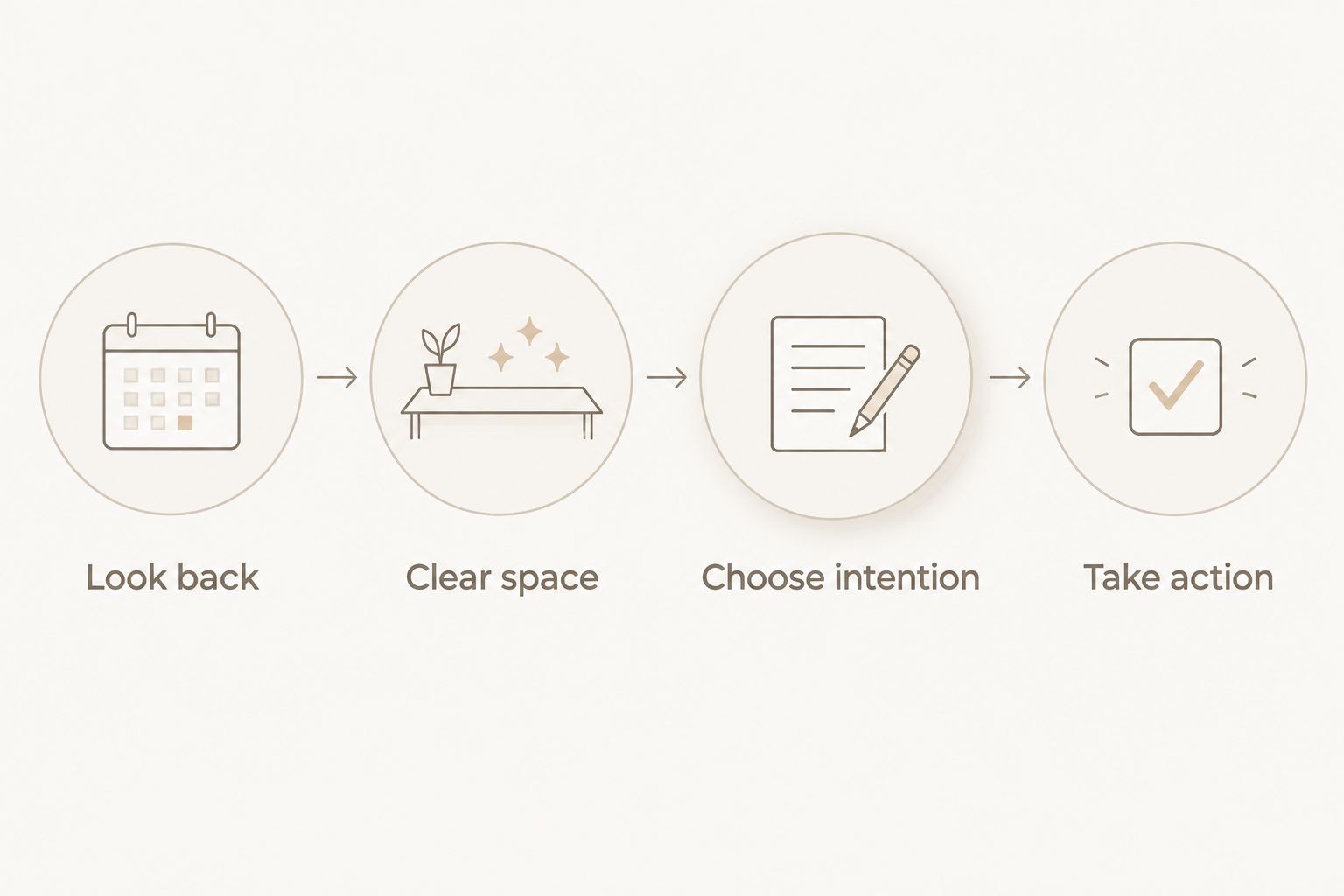
Look back, clear space, choose an intention, and take action. Follow that sequence before adding music, candles, symbolic objects, or a longer journaling session. The practical decisions are the ritual's foundation.
- Look back. Review your calendar and recent notes. Name something that supported you and something that needs to change.
- Clear space. Remove a small obstacle: an unresolved appointment, a crowded work surface, or a commitment you need to reconsider.
- Choose intention. Write how you want to approach the coming month, in language you can act on.
- Take action. Put the next step somewhere you will see it, with a clear occasion for doing it.
If symbolism is part of your practice, setting intentions with crystals can sit alongside these steps. It does not replace them. A meaningful object can mark your decision; it cannot make the decision happen.
Why this matters: reflection needs somewhere to go
A reset is not an instruction to erase the previous month. You can carry forward unfinished work, a difficult feeling, or a routine that already suits you. The useful question is what deserves your attention now.
Separate what happened from what you want to do about it. A crowded calendar is an observation; declining a recurring commitment is a decision. Feeling disappointed is an experience; asking for feedback is an action.
Do not turn a monthly reset into a verdict on your character. Review your choices and circumstances, not whether you were a sufficiently productive person. You are making room for the next month, not grading the last one.
Look back without writing a life report
Open your calendar, messages, or journal and look for actual events. Start with the week you remember least clearly rather than relying entirely on the mood you are in today. Record what happened before interpreting it.
Use these prompts:
- What felt worthwhile enough to keep?
- What repeatedly asked more of me than I wanted to give?
- What did I postpone, and what made starting difficult?
- What changed that my plans did not account for?
- What is still unfinished but still matters?
You do not need an answer to every prompt. Choose the questions that reveal a decision. If you already know an appointment needs booking, write the task rather than searching for a deeper meaning.
Keep observations specific. Instead of describing the whole month as chaotic, name the late meetings, missed meals, or unclear requests that made it feel that way. Specific observations give you something to address; broad labels leave the problem intact.
Include what worked, even if it was ordinary. A walk after work, a prepared lunch, or a conversation you did not avoid can be worth repeating. Your next month does not need to contain only new habits.
Clear space without making a cleaning project
Choose one place where something is getting in your way. It can be physical, administrative, or relational. The aim is to make an intended action easier, not to make your home look finished.
For a physical reset, clear the surface where you want to write or prepare for the day. Put away what belongs elsewhere. Stop when that space serves its purpose; the rest of the room does not need to become part of the task.
For an administrative reset, identify the loose end you keep remembering. Book the appointment, find the document, or write the question you need answered. If another person must respond, distinguish sending the request from receiving the outcome.
For a commitment reset, look at what you have already agreed to do. Decide whether to keep it, renegotiate it, or decline it where that is possible. Deleting a task from your list does not cancel a promise to someone else; communicate the change.
Clear the obstacle closest to your intention. If your intention is to protect your evenings, reorganizing a drawer is less relevant than reviewing late appointments. Choose useful over impressive.
Choose an intention you can recognize in action
An intention describes your approach. A goal describes something you want to accomplish. Both can belong in a monthly reset, but they do different jobs.
For example, completing an application is a goal. Preparing carefully rather than rushing is an intention. Write the application task in your calendar and keep the intention beside it as a reminder of how you want to proceed.
Use ordinary words. Patience, care, steadiness, honesty, or attention can work if you explain what they mean in your circumstances. A beautiful word without a corresponding choice gives you little to return to.
| Intention | What it means this month | A practical next step | What it does not promise |
|---|---|---|---|
| Attention | Make deliberate room for important work | Close unrelated tabs before starting | Constant concentration |
| Honesty | Speak clearly about a limit | Prepare the request before a difficult conversation | Agreement from the other person |
| Care | Treat an ordinary need as worth planning for | Add a meal or appointment to the calendar | A month without difficult days |
| Steadiness | Return to an unfinished task without restarting everything | Leave a note describing where to resume | Perfect consistency |
Choose one intention for the ritual. You can still have several responsibilities, but the reminder itself does not need to carry all of them. Give one intention one recognizable expression.
Take action before closing the notebook
Write a next step that begins with a verb: send, book, ask, prepare, put away, or decline. If your note says to become more confident, make it concrete enough that you can tell whether you acted on it.
Then connect the action to an occasion. Preparing a question before your next meeting is clearer than promising to speak up more. Setting out what you need before leaving home is clearer than deciding to be organized.
Check whether the action depends on something you control. You can submit an application; you cannot schedule the employer's decision. You can invite someone to talk; you cannot require them to respond as you hope.
Leave a brief record for your next reset:
- The intention you chose.
- The action you planned.
- The occasion when you intended to act.
- What you will review next month.
Do not add a second project just because the first action looks small. A useful reset can end with a sent message or a prepared question. Close the notebook once you know what comes next.
Choose a format that fits how you already keep notes
Use the format you will actually return to. You do not need a separate system for reflection if your current notebook or phone notes already hold the details of your day.
| Format | Best for | Advantage | Limitation |
|---|---|---|---|
| Paper notebook | People who want a screen-free pause | Keeps reflection separate from notifications | You need the notebook nearby to review it |
| Phone note | People who capture thoughts throughout the day | Lets you keep the reset beside existing notes | Notifications can interrupt the session |
| Calendar entry | People whose next step needs a specific occasion | Puts the action beside upcoming commitments | Offers less room for longer reflection |
You can combine formats without duplicating everything. Keep the reflection on paper and put only the action in your calendar. If maintaining the system becomes another obligation, simplify it.
A monthly reset worksheet for 2026
Copy this into the place where you keep your notes. Answer in fragments if full sentences slow you down. The worksheet is a starting point, not a form you must complete.
- Month reviewed:
- Something to keep:
- Something that created friction:
- An unfinished task that still matters:
- Something to stop or renegotiate:
- My intention for the coming month:
- The action that expresses it:
- When I will take that action:
- What I want to check next time:
For a March 2026 review, you might notice that answering requests immediately kept interrupting work you had already planned. An April 2026 intention could be attention, expressed by checking your calendar before accepting another commitment.
That example is not a rule about productivity. Your intention might concern friendship, rest, household responsibilities, or asking for help. Keep your 2026 reset tied to the life you have, rather than an imagined version with unlimited time.
Why your monthly reset will vary
Keep the sequence, but change its depth to suit the month. These factors belong in your review:
- Your commitments. A month with appointments and deadlines needs attention to the calendar.
- Unfinished work. Some tasks need continuation rather than a fresh goal.
- Changed circumstances. A move, new responsibility, or canceled plan changes what is realistic.
- The obstacle involved. A cluttered surface needs a different response from an unclear agreement.
- Your preferred format. Speaking, writing, and reviewing a calendar provide different ways into reflection.
Variation is not failure. If the same worksheet stops helping, keep the questions that lead to decisions and remove the rest.
Can a monthly reset be a spiritual ritual?
A monthly reset can include spiritual reflection when that is meaningful to you. You can mark the transition with silence, a personal symbol, or an intention written by hand, without treating the ritual as a prediction or guarantee.
Animaelle natural-stone jewelry fits this practice only as an optional personal reminder. If you want a wearable object, an Amethyst Bracelet is one example to consider; check its current material and fit details before choosing it.
A bracelet lets you carry a chosen reminder, but it also needs fit and care attention. It does not change your circumstances, improve concentration, or protect you from an unwanted outcome. For elastic-cord jewelry, keep it dry and take it off at night.
Animaelle jewelry is optional; an existing object or written note is enough. Give the object one personal meaning, then return to the action you chose.
What if you miss the beginning of the month?
A monthly reset does not require the first day of the month. Choose a transition you can recognize: closing the previous month's calendar, preparing for a new work period, or returning after time away.
Do not make a missed date another unfinished obligation. Review what matters now and choose the next step from here.
How do you know whether your intention helped?
An intention is useful when you can identify a choice it informed. At the next review, ask where you acted on it, where you forgot it, and whether the wording still fits.
Do not judge it by whether the month went smoothly. A difficult month can still contain a clear boundary, a completed task, or a request for support.
FAQ
What should I do during a monthly reset?
Review the previous month, clear one relevant obstacle, choose an intention, and give it a practical next step. Finish by recording when you will take that step.
Do I have to do a monthly reset on the first day?
No, a monthly reset can happen when you have a useful opportunity to review and plan. Use a recognizable transition rather than treating a missed date as a failure.
What is the difference between an intention and a goal?
An intention describes how you want to approach something; a goal describes what you want to accomplish. Pair them by choosing an action that expresses your intention while moving the goal forward.
Can I do a monthly reset without journaling?
Yes, you can review your calendar and record only the decision and next action. Longer writing is optional, not a requirement for reflection.
Do I need crystals for a monthly reset ritual?
No, crystals are not necessary for a monthly reset. Animaelle jewelry can serve as an optional personal reminder, but it does not produce medical, financial, protective, or spiritual outcomes.
What if the same problem comes up every month?
Review the obstacle and the action you chose rather than repeating the same intention unchanged. Clarify the task, renegotiate the commitment, or identify the support you need.
Can I keep the same intention for another month?
Yes, keep an intention if it still matches your circumstances and leads to useful choices. Continuation is a valid decision; you do not need a new theme every month.
One last thing
Your next reset can begin by deciding what not to change. Keep a routine that already serves you. Leave a completed task completed, and resist turning every ordinary difficulty into a new self-improvement project.
If you choose a stone as a reminder, choose it after the intention is clear. Consider how it will feel in everyday wear, check the sizing guidance, and measure your wrist before deciding. Nothing needs to be bought for the ritual to count.