

Choose crystals by checking the material first, choosing a meaning you want to remember, and setting a spending limit before browsing. Then pick a form that fits your day: something to wear, hold, or keep on a desk. In 2026, the useful distinction is still between a stone’s physical properties and the personal symbolism you give it; neither a higher price nor a meaningful name guarantees an outcome.
- How to choose crystals: check material, choose one personal intention, then consider fit, care, and your budget.
- Amethyst and rose quartz suit buyers who prefer quartz; fluorite needs more protection from scratches and knocks.
- Animaelle natural-stone bracelets suit people who want an everyday reminder, not a promised outcome.
- Choose nothing if the material is unclear, the fit is wrong, or the purchase strains your budget.
How to choose crystals by meaning, material and your budget
Choose the stone you understand, the meaning you can put into words, and the form you will actually use. A crystal does not need to match every intention in your life. Start with a single purpose, such as remembering to pause before answering or making time for someone you love.
For wearable choices, keep everyday stone, fit, and care beside the meaning in your decision. A bracelet that catches on your sleeve is not a good everyday choice simply because its symbolism appeals to you.
Start with a purpose
Ask what you want the object to remind you to do. Make the answer observable: listen without interrupting, review your spending, or begin the task you have been avoiding. This gives the intention somewhere to go beyond the purchase.
If you only want a beautiful stone, that is enough. You do not need to add a spiritual explanation to an aesthetic preference.
Check the material
Read the material description before the symbolic description. Look for a named stone and clear information about any treatment or manufactured components. Natural origin, treatment, and imitation are separate questions.
A poetic product name does not identify a mineral. If the listing leaves you unsure what you are buying, ask before choosing.
Choose the form
Decide whether you want to wear the stone or leave it somewhere visible. A bracelet is portable, but fit and construction matter. A desk object avoids wrist-fit questions, but takes up space and is not a wearable reminder.
Choose the form around your existing routine. Do not invent a complicated routine just to justify an object.
Set the limit
Decide what you are comfortable spending before comparing listings. Include delivery and any other charges shown at checkout. Do not stretch the limit because a description promises stronger energy, protection, or abundance.
Check the care
Read the care instructions for the finished item, not only the mineral. A stone, cord, clasp, and metal setting can have different needs. If the care is more work than you want, choose another material or skip the purchase.
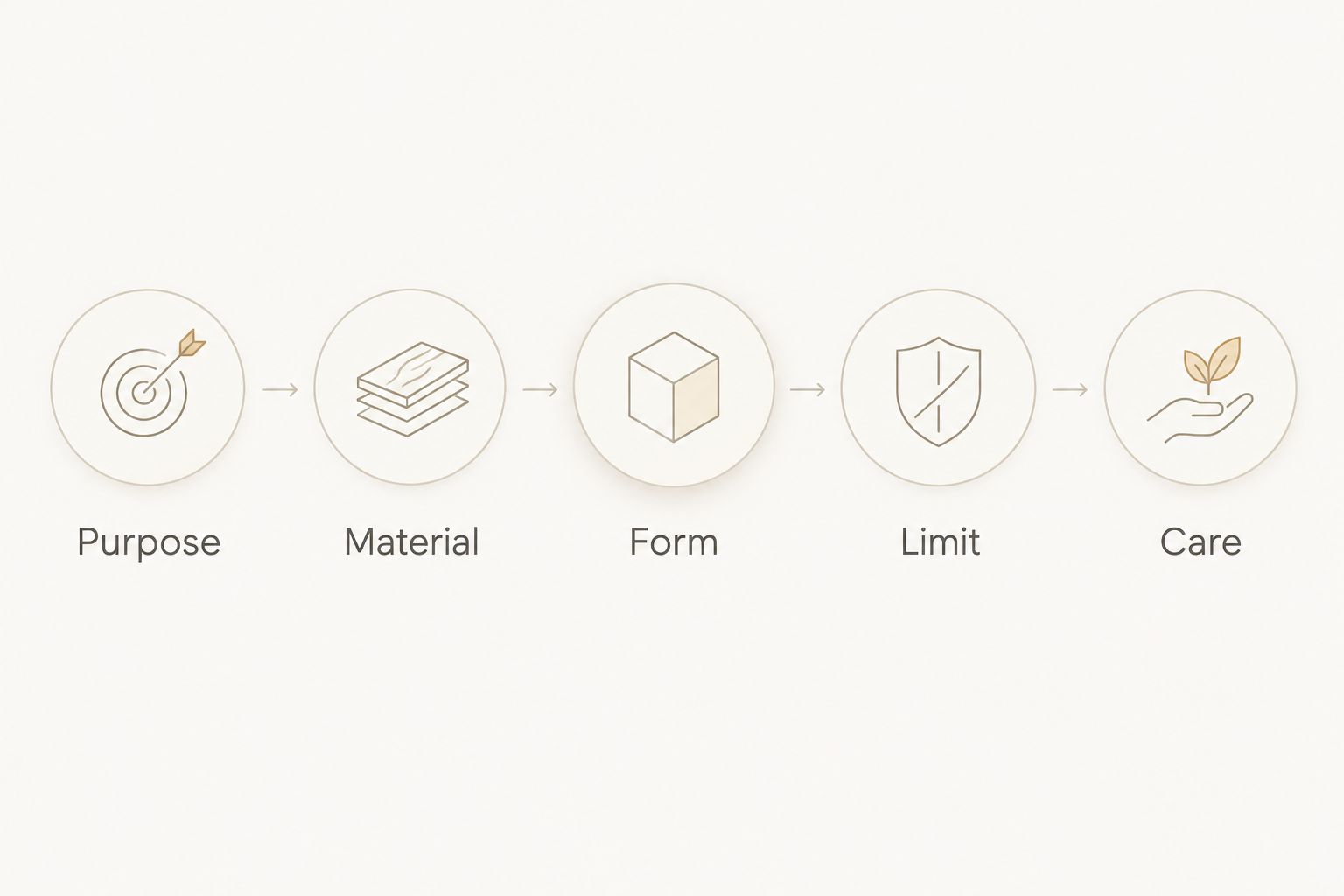
Why this choice matters
Meaning and material answer different questions. Meaning helps you decide what the object represents. Material helps you judge whether it suits the way you intend to use it.
Confusing the two makes shopping harder. A stone described as protective still needs physical care, and a stone associated with clarity does not make decisions for you. Use symbolism to name your intention, not to predict a result.
For a 2026 purchase, keep those questions separate even when a listing combines them. You can enjoy a crystal’s appearance and personal significance while asking ordinary questions about its identity, fit, and construction.
Compare the materials before the meanings
Amethyst, rose quartz, and fluorite offer a useful starting comparison. The first two are varieties of quartz; fluorite is a different mineral. Their colors can appeal for different reasons, but their scratch resistance is not the same.
| Choice | Material and appearance | Best for | Advantage | Limitation |
|---|---|---|---|---|
| Amethyst Bracelet | Amethyst is purple quartz | Someone who wants purple stone in a wearable form | Quartz has greater scratch resistance than fluorite | Bracelet fit and construction still need checking |
| Rose quartz | Pink quartz | Someone drawn to a soft pink stone | Quartz offers the same mineral hardness as amethyst | Its association with love is symbolism, not a relationship outcome |
| Fluorite | A mineral found in several colors, including purple and green | Someone willing to handle a softer stone carefully | Offers a different material and color choice | Scratches more readily than quartz and has cleavage |
In gemology, quartz has a hardness of 7 on the Mohs scale. Fluorite has a hardness of 4 on the Mohs scale. These are mineral properties, not product-specific test results.
Hardness describes resistance to scratching. It does not measure every kind of durability, and the scale is not linear. A harder stone can still chip; a finished bracelet can still fail at its cord or fitting.
For 2026 shopping, use hardness as a comparison point rather than a guarantee. Ask how the whole item will behave against desk edges, neighboring jewelry, and the movements of your ordinary day.
Amethyst: purple quartz with a personal meaning
Best for: someone who likes purple and wants a reminder to pause. Amethyst belongs to the quartz family and has a hardness of 7 on the Mohs scale. Its color is a material feature; any intention attached to it is a separate choice.
In contemporary crystal symbolism, amethyst is often associated with calm and reflection. You can use that association to remember a practical action, such as taking a breath before replying. It is not evidence that the stone treats anxiety or changes your emotional state.
The advantage is a clearly named quartz variety. The limitation is that mineral hardness says nothing about bracelet size, cord condition, or resistance to every knock.
Rose quartz: pink quartz without a promise about love
Best for: someone who likes pink and wants a reminder of kindness or connection. Rose quartz is a pink variety of quartz with a hardness of 7 on the Mohs scale. Choose it because you enjoy the material and can name what it represents to you.
In contemporary crystal symbolism, rose quartz is often associated with love. A grounded intention might be to make time for a conversation, express appreciation, or keep a boundary that protects your well-being.
Its advantage is that color and intention can be considered independently. Its limitation is the expectation sometimes attached to it: rose quartz does not attract a partner or repair a relationship. Those outcomes depend on people and actions.
Fluorite: a softer stone that asks for more care
Best for: someone who values fluorite’s appearance and accepts careful handling. Fluorite has a hardness of 4 on the Mohs scale, below quartz. It also has cleavage, meaning it can split along particular planes in its crystal structure.
That makes physical care a more important part of the decision. Consider where the stone will encounter abrasion or knocks rather than choosing only from a photograph.
In contemporary crystal symbolism, fluorite is often associated with focus. Treat that as a possible reminder to clear your workspace or begin a task, not a claim that fluorite improves cognition. Its visual appeal is an advantage; its lower scratch resistance is a trade-off.
Why your crystal choice varies
There is no single stone that fits every buyer. These factors change what makes sense for you:
- Material identity: A named mineral gives you something concrete to evaluate. A broad description such as green crystal does not.
- Personal intention: Choose the meaning you want to remember, rather than collecting promises about unrelated outcomes.
- Daily contact: A wrist-worn stone encounters sleeves, surfaces, and other jewelry. A desk object has a different handling pattern.
- Fit and construction: The right mineral does not compensate for an uncomfortable bracelet or unclear sizing.
- Care requirements: Choose something whose care instructions fit your habits. Do not assume every stone tolerates the same cleaning method.
- Spending comfort: A suitable purchase stays within your limit. Spending more is not evidence of greater spiritual value.
Color is a valid deciding factor when the practical checks are satisfied. You are allowed to choose the stone you like looking at, without turning the decision into a test of intuition.
How to keep the choice within your budget
Set a maximum total before opening several product pages. Then compare only items that meet your material, form, and care requirements. This keeps an appealing description from quietly changing the decision.
For a 2026 purchase, read the full checkout total rather than judging only the displayed item amount. Delivery and other applicable charges belong inside your limit. Leave the purchase unfinished if the total no longer feels comfortable.
Do not pay for a promised outcome
A claim that a stone brings money, guarantees protection, or makes love arrive is not a material specification. It does not tell you the mineral, treatment, fit, or workmanship.
You can value symbolic language without using it as proof. Keep the personal meaning; discard the guarantee.
Compare like with like
Compare the same kind of object where possible. A wearable item and a decorative object serve different purposes, so their appeal alone does not make them interchangeable.
Look for clear material descriptions, dimensions where relevant, and care information. If details are absent, ask rather than filling the gaps with assumptions.
Give yourself permission not to buy
A note in your pocket or an object you already own can carry an intention. Buying a crystal is optional, even when the symbolism feels meaningful.
If none of the choices fits your limit, stop browsing. The intention can begin without the purchase.
Check how a bracelet will actually wear
Measure your wrist with a flexible tape, or use a strip of paper and measure that against a ruler. Keep it comfortably against your skin without pulling it tight. Compare your measurement with the item’s stated sizing instructions; do not assume wrist circumference and bracelet size mean the same thing.
Consider your working day. Will the bracelet sit against a keyboard, catch under a cuff, or touch other jewelry? These questions are more useful than choosing a size from a photograph.
Animaelle natural-stone bracelets are best for people who want an everyday personal reminder, not a promised outcome. Still, choose each item by its own material, sizing, and care details. A meaningful choice is not automatically a comfortable one.
For elastic-cord jewelry, take the bracelet off at night. In 2026, keep the same practical boundary around symbolic use: you can place a reminder in your evening routine without sleeping in the bracelet.
Can I choose a crystal just because I like its color?
Yes. Liking the color is enough. Check the material, fit, and care, then let your preference decide. You do not need to accept a symbolic association that feels wrong or invent an intention to make the purchase legitimate.
Aesthetic enjoyment and personal meaning can coexist. Neither has to justify the other.
Do I need to choose a crystal by my zodiac sign?
No. A zodiac association is an optional symbolic starting point, not a requirement. Choose the stone that suits your taste and use, even when a zodiac list suggests something else.
If astrology matters to you, let it help you reflect on an intention. It does not establish a stone’s material properties or predict what wearing it will do.
How can I tell whether a crystal is natural?
Start with the seller’s material description and treatment disclosure; appearance alone does not authenticate a stone. Natural, treated, synthetic, and imitation describe different things. Ask what those terms mean for the specific item.
Do not rely on a home scratch test. It can damage the piece without giving you a reliable identification. If material identity is central to your purchase, seek clearer documentation or qualified assessment.
FAQ
What's the best way to choose crystals for the first time?
Choose a clearly identified material, a form you will use, and a spending limit you can keep. Add one personal intention only if you want one; a crystal is not required to begin a habit.
Is amethyst better than fluorite for everyday wear?
Amethyst has greater scratch resistance: quartz is 7 on the Mohs scale, while fluorite is 4. That comparison does not guarantee the durability of a finished bracelet, whose construction and care also matter.
Can I choose rose quartz if I am not looking for love?
Yes, you can choose rose quartz simply because you like pink quartz. Its association with love is optional symbolism, not a rule about who should wear it.
Does a more expensive crystal have stronger energy?
A higher price does not establish stronger energy or a better personal outcome. Evaluate the material and finished item rather than treating the amount spent as proof of an effect.
Do I need several crystals for different intentions?
No, you do not need several crystals. Choose one intention for a piece, or use an object you already own as a reminder.
Should I wear an elastic crystal bracelet while sleeping?
No, take elastic-cord crystal bracelets off at night. A bedtime intention does not require wearing jewelry while you sleep.
What should I check before choosing an Animaelle bracelet?
Check the Animaelle bracelet's stated material, sizing instructions, and care guidance. Choose it as an optional personal reminder, not as a treatment or a guarantee of love, protection, wealth, or success.
One last thing
Write the intention as an action before choosing the stone. Listen before answering is more useful than better relationships. Review my spending is more useful than abundance. The stone can remind you of that decision; it does not make the decision happen.
If a bracelet still feels right, measure your wrist and choose a stone you enjoy seeing in ordinary daylight. If nothing fits, keep the intention and leave the purchase.